
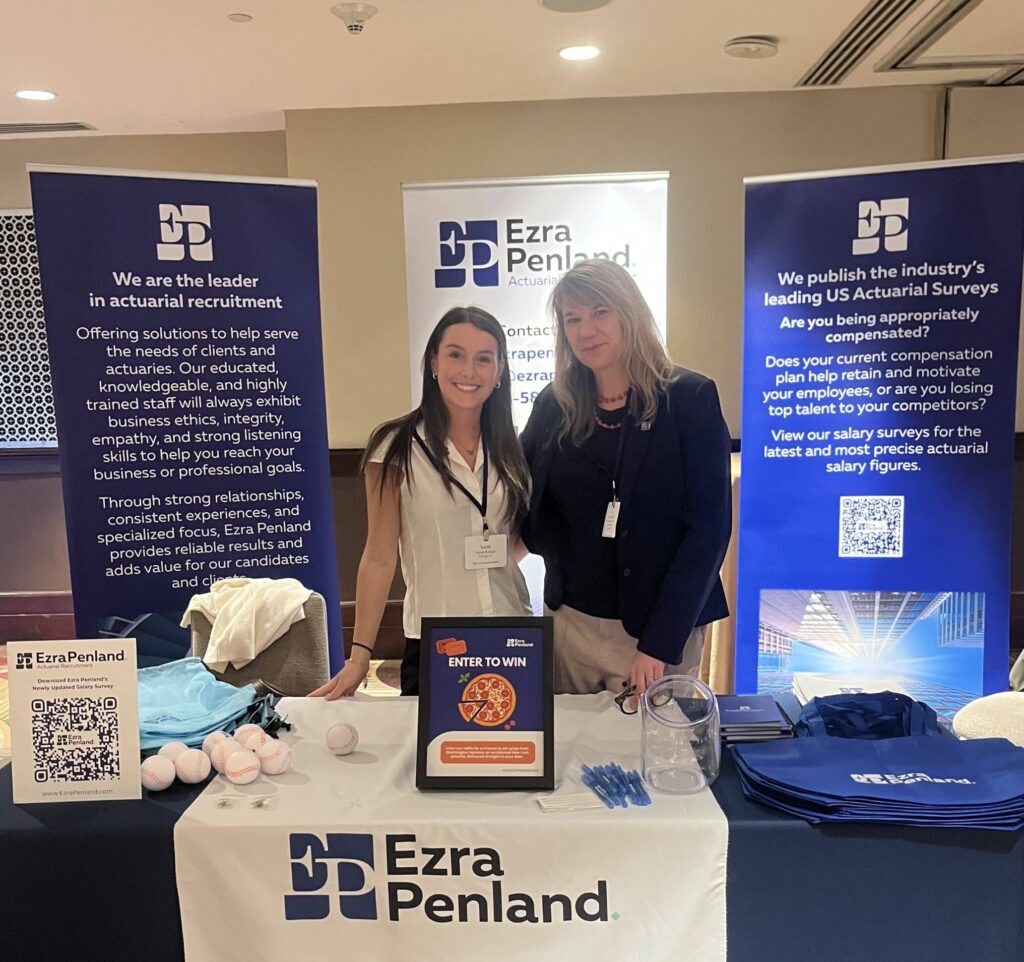
Our team joined actuaries from across the industry for an energizing few days of sessions, networking, and big ideas at the Casualty Actuarial Society’s Spring Meeting in New York City.
From a newly unveiled visual identity to sessions probing the limits of AI, data bias, and professional qualification, the program was dense and thought-provoking. We left with sharper thinking on some of the profession’s most pressing questions, and more than a few new connections from one of the best networking events of the year.


A New Look for the CAS
CAS President Barry Franklin unveiled a refreshed brand identity and new logo during the welcome reception, a deliberate modernization effort designed to signal that the organization is evolving alongside the profession.
The rebrand is less about aesthetics for their own sake and more about positioning. The goals include reaching the next generation of actuaries, reinforcing CAS’s authority in an era of analytics and AI, and building a more consistent global presence. Key objectives behind the refresh include appealing to younger actuaries and future members, better reflecting innovation and evolving risk landscapes, and strengthening global recognition across member communications.
Sessions Attended
“Where the Surprises Hide in Reserving”
Speakers: Michael Henk, FCAS, MAAA, Actuary at Akur8 | Kayla Robertson, FCAS, MAAA, VP – Reserving Actuary at GUARD
Reserve problems don’t always announce themselves. This session focused on the hidden corners of loss triangles and smaller segments where issues can quietly develop before they become obvious, and on the structured review methods that help actuaries catch them early.
The central message was that analytics exist to support judgment, not replace it. Better tools help focus attention on what’s unusual, but the actuary still does the work that matters most. Systematic review tools surface the segments that most deserve a closer look, and the combination of structured analytics and professional expertise reduces the risk of missing important reserve movements.
“Actuarial Epistemics: Truth in the Age of AI”
Speaker: Tetteh Otuteye, FCAS, Actuary & Risk Management Executive
This was one of the more philosophically ambitious sessions of the conference. As AI tools proliferate and data becomes easier to manipulate or misread, the question of what we can actually know and trust in actuarial work becomes more urgent.
Otuteye argued that the actuary’s role isn’t just model-building but model-testing. Protecting the integrity of predictions and the financial stability that depends on them means actively challenging results rather than accepting them at face value. AI improves decision-making but introduces new risks when outputs go unscrutinized, and skepticism and validation are not obstacles to efficiency. They are core professional responsibilities.
“Are You Qualified? Professional Session”
Speakers: Ronald Kozlowski, FCAS, MAAA, Lead Consultant at RTK Actuarial | Kristan McGraw, ACAS, MAAA, Senior Consultant at Cognalysis | Robert Wolf, FCAS, CERA, MAAA, SVP/Chief Actuary at Stonetrust
Being credentialed and being qualified are not the same thing. This session tackled one of the profession’s more uncomfortable questions head-on, asking how actuaries should honestly assess whether they are truly prepared to take on a given assignment.
The answer depends on more than letters after your name. Relevant experience, subject matter knowledge, and familiarity with the specific regulatory context all factor in. Qualification is assignment-specific, not credential-specific, and when gaps exist, collaboration or additional learning is the professional path forward.
“How Data Bias Can Derail Insurance Decisions”
Speaker: Mark Ma, CPCU, VP Data Science, Greater NY Mutual Insurance
Strong models built on flawed data produce flawed answers. This session drew out a critical but often overlooked truth in that the sophistication of an algorithm offers no protection against the biases baked into the data it trains on. Hidden errors can distort pricing, underwriting, claims outcomes, and broader strategy, sometimes in ways that are hard to detect until the damage is done.
Automated tools and machine learning can even amplify bad assumptions, which makes active data quality testing more important, not less, as modeling capabilities advance. Actuaries and data professionals must test data quality proactively, not simply trust model outputs
Tuesday Night Event: Intrepid Sea, Air & Space Museum
The CAS hosted a private networking event at the Intrepid Sea, Air & Space Museum in New York City, renting out the venue exclusively for conference attendees. Guests were able to explore aircraft carrier exhibits and space artifacts without the usual public crowds, creating a one-of-a-kind backdrop for an evening of great conversation and connection. It was a memorable way to cap off a full day of sessions and a highlight of the trip for our team.

Looking Forward
The CAS Spring Meeting reinforced several themes our team is tracking closely. The growing importance of human judgment alongside AI tools, the complexity of data quality in a machine learning world, and what it really means to be qualified in a profession that’s expanding faster than any single credential can capture are all topics we’re continuing to follow.
We’re energized by the conversations we had and the ideas we’re bringing back. If you’d like to discuss any of these topics further, don’t hesitate to reach out to our team.